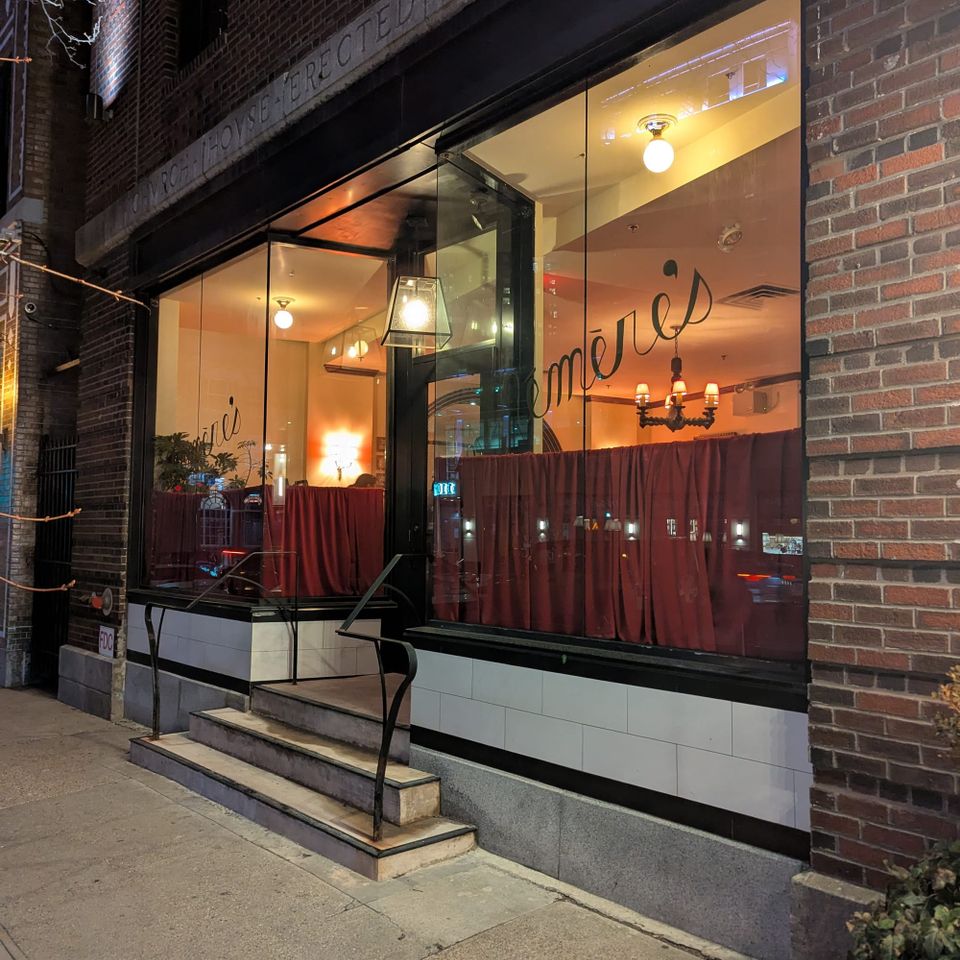
012: Screaming Unicorn
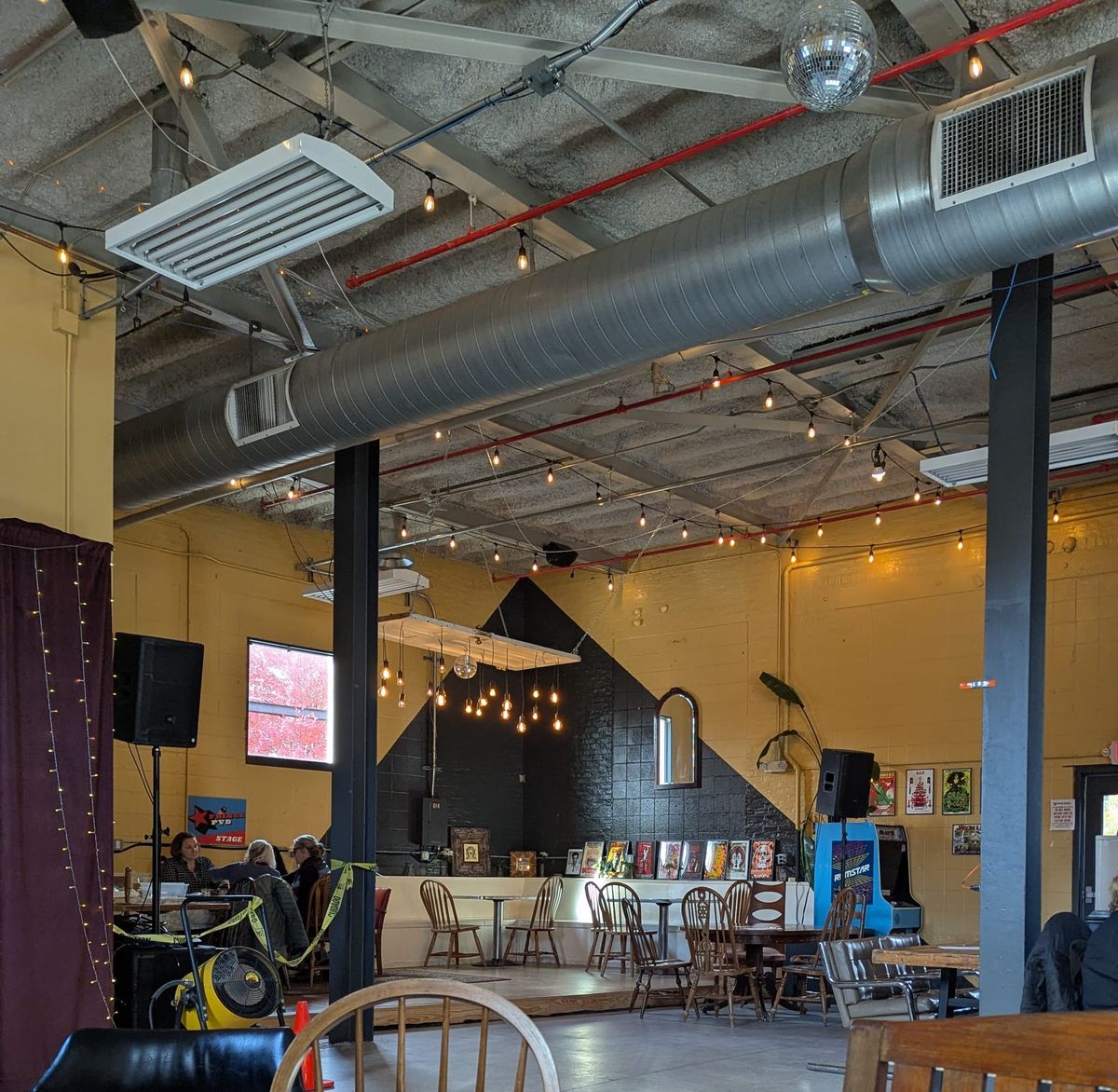
This is Screaming Unicorn.
There is an immediate charm here when you walk in that none of the furniture matches. It's a very large warehouse space; sometimes you come in through a proper door, sometimes you enter through a lifted garage door on what used to be a loading dock, and most of it is dedicated to Buttonwoods Brewery, but Screaming Unicorn lays claim to its section with mismatched tables and chairs. You're as likely to find a pleather easy chair as you are a wooden dining chair with a low seat and a back made of spindles. The five members of your eight-person writing group who've gathered here after workshop have picked out a round table from the motley crew of options available.
This is the third or fourth time you've been here as a group. The last time there was a wink and a nod from your group members that the visit would be a How to Eat a City essay, and you said it would, even took down the notes, but then you blew your own deadline. This time you warn them it might be a deadline. You offer editorial control, and they bat it away out of politeness.
As you're walking over from LitArtsRI, there's a brief discussion of how long everyone has been part of the group. It is striking to realize you're now something of a veteran member. You remember your first session, you and seven women, and thinking that, like your knitting group, you had intruded into a space not meant for you. But as with your knitting group, the founder was nothing but pleased with your presence, and the welcome grew from there (although you perhaps never integrated as well into the knitting group as the writing group). Now there are only three members who joined the group before you, and four who have joined after make you feel like...well, like a piece of the eclectic furniture.
There is a brutal heat given it's only June, and there is outdoor seating and a live band, as well as a special of oysters and pork, apparently all part of an event none of you realized was going on, perhaps because what goes on down in this part of Sims Ave is often as much a mystery to you as the interior of the nearby Fantasies club: you can guess, of course, but you're not informed enough to know. Because of the heat, you stick indoors, even if it means you can't hear the band. You can order the pulled pork sandwich, though, part of the special. It takes the staff a bit getting set up, so lunch service doesn't start until about half an hour after your group arrives, and then you must stand in line and order with the people who have stacked up in the delay. The venue fills further after service starts.
Your group's leader, though you expect she'd take some mild umbrage with the term as she takes pains to act more as a magnanimous first among equals, orders oysters for herself and fries for the table, which is good because the pulled pork sandwich does not come with the usual side of fries. Screaming Unicorn has a quality french fry that comes flavored in some sort of spice mix that's a little savory and a little sweet, like the "Mesquite BBQ" flavor you can find in a bag of potato chips, though not nearly as pronounced or sugary.
Of your five, three are the members who have been there longer than you. When you joined, you thought they'd been at it a year, given the familiarity they seemed to evince with one another, but you've since learned that the group only started a few months before you joined. There's a lovely, bouncy energy being here. The first time you came as a group, you all sat too close to the speaker and one of you had to ask to turn it down, your social anxiety leaving you internally mortified at the imposition on space and staff. Now, though, they've moved the sound system around and there's a buoyant pleasure when the staff comes around to hand out menus and let people know about the specials when service starts. You are smiles and laughter. It feels familiar, like something sliding into perfect place, like joining a mortise and tenon cut with such precision there's no give in the completed joint in woodworking.
Writing groups can be a difficult dynamic. Members must trust one another and they must be open to hearing feedback they never expected to hear and open to not hearing the feedback they'd hoped to hear. Audience and artist have a push/pull relationship, one that can be gentle or violent depending on the people, the work, or even from sentence to sentence. For generating fresh writing, you want a receptive audience that trusts you back, that's willing to look at the fragments you give them and can chart the path and see where you're going, and give you a gentle tap on the shoulder and steer you back if you're veering off into the bramble thicket of the incomprehensible.
It's a specific alchemy, then, to get a writing group like this. The pitfalls are so many: a person could be too brusque in their corrections, or unwilling to trust your writing, or impolitic and opinionated. Something as apparently trivial as the feedback's diction itself can be devastating, and this can be deployed inadvertently by even the best readers. And yet, somehow, this group has made it work, stepping backward blindfolded onto the tightrope wire every second Saturday of the month and making it clear across to the other side.
You had a group like this at your college, Warren Wilson, you and three other creative writing program students, all women, who'd all taken a fiction course together and were assigned together. But after you realized you just trusted each other, so you kept reading each other's work and giving feedback. You meant to keep at it after graduation, but this proved to be one of those things you say you will do in college, but is much harder to manage when you're not all living in the same half mile of the Blue Ridge Mountains in North Carolina. And, to be honest, for many years after graduating, you had barren yields of words, so there was nothing to offer up or collect feedback on.
One of the "perks" of being a senior writing student was that you got to sit in on the winter semester of the low-residency Master of Fine Arts program that descended on the campus over the winter break. You got to return to Swannanoa with them, rejoining the skeleton crews of students that managed the work college's many tasks while the majority of the student-workers were on break, as well as the instructors and students in the MFA program, all of whom seemed so much more adult than you. One, in particular, was the actor James Franco, half a decade before #MeToo exposed him.
It's pure rumor and you forget which person said it, but there was a story that Franco had taken a third year of the two-year program. As the story went, this was reserved for people who either had such busy and disruptive lives that they couldn't manage the pair of ten-day intensive residencies of each year or the continuing distance learning work between them, or their work was bad. Franco, as you recall, was there for poetry, one of several advanced degrees he was seeking at the time. You cannot say that you are any good at poetry, so far be it from you to judge, but he did release a book of it and it was critically savaged (people were particularly dismissive of one poem that seemed to be a bitter recrimination about the late Heath Ledger).
Your paths crossed a single time, in what is one of the stranger encounters you've had with a human being. You checked your mail in the basement of the student union, then sat on a couch and read the Mountain Xpress, Asheville's alternative newspaper. You are the only person in this area of the student union. In those days, you used to get a Mounds bar and an RC Cola (the Third Way of cola sodas) from the store, but you can't recall if you did that day. As you read, a man belly flopped over the arm of the couch opposite you, landing face down onto the cushions. James Franco. You recall a dramatic, exaggerated sigh.
Now, your sister had moved to Los Angeles a few years before, and one thing she had told you about was that Angelenos learn to mind their own damn business about celebrity, and so the respectful thing to do is to not remark about how they're a famous persona, but rather let them go about their lives. This appeals to you both on the logic that no human is inherently superior to any other, and as a born Yankee whose preferred mode of communication with strangers is a knowing nod, politely acknowledging that the other person exists without piercing the veil of privacy in either direction.
So, if James Franco wants to flop onto a couch and then pretend to be tired, you let him do that and continue with your newspaper.
You have been told that Franco has a clique in the MFA program, and sure enough a young woman, not an undergraduate, appears at the couch and crouches down and asks if he would like her to retrieve a meal from the cafeteria for him, since she knows he doesn't like to go in there, presumably for celebrity-based reasons. You recall a smile that some might call gracious, others might read as self-satisfied, as he assented.
You will never shake the impression that, for some unfathomable reason, he seemed to be trying to get your attention without directly requesting it, but for whatever reason, most likely social anxiety, you soon stood and continued about your day.
Each year, one recent graduate of the MFA was selected to teach the course the undergraduate students who sat in on the MFA program took, which guaranteed them a year of employment and often enough led them to stints as adjuncts in the writing department. They alternated a poet or a fiction writer by year (no year for your concentration, creative nonfiction). The year you participated it was a poet, and you had that sort of furious crush on her you can only really get on someone not so significantly older than you but who also wields a position of authority. As far as the MFA program went, she was something of a rarity: many of the MFA students were continuing education, people who had established careers in other fields or had their writing put on hold by the turns of life and were coming back to it, and virtually none of them had been to undergraduate at the college, which at the time boasted a student body of just over 900 in total, and in the decades past had been even smaller. But the poet had been an undergrad, just like you, which meant she had gone through the work program, just like any other four-year residential student had, and thus appreciated the ethos of the college, and understood that, except for the writing cohort, the undergrads the MFA students saw about on campus were at work, not at study, dutifully laboring away to maintain the campus under the supervision of professionals. Like you, she'd been to the Homecoming and Reunion weekend where the school put on a pig roast, your understanding that the pig itself came from the college's farm, and the pulled pork thus shared with the tangy North Carolina BBQ sauce to every student and alum also raised by students. She also (and this might also have something to do with your crush) had long dark hair which cascaded in curls and face that seemed to set into a piercing stare that found a hybrid of forlorn and skeptical at the briefest of provocations, tucked under a southern accent.
All of your cohort gathered at a bar off campus one night, you seem to remember because the MFA program students were at their own reception which the undergraduates were not to mingle with (you sat in on the daily lectures and the nightly readings and nothing else). She told you she was working on a new poem, all about the various big cats in each region of the country: the panther of the south, the puma of the southwest, the mountain lion of the west, the cougar of the northeast, and so and so forth.
"Those are all the same cat, aren't they?" you'd asked.
"No. Are they?" she'd responded.
"I think so," you'd said, making an attempt to wince, as though it also hurt you to share a fact with someone who didn't know it (it did not, sharing facts is like eating a pulled pork sandwich, to you). They are all, indeed, the same cat: puma concolor. In fact, the animal has an attested forty English names, including the ones listed above and others such as Painter, Wild Cat, Catamount, Deer Tiger, Mountain Screamer, American Lion, Sneak-cat, Mountain Devil and more besides, making it one of the single most named species in the world.
Still, you did feel some empathy at the look of disappointment on her face, knowing you'd just undercut the basis for her poem. In the haughtiness of your early 20s, the thought occurred to you that poets are often quite attractive, maybe not as clever as prose writers. Something to do with primacy of diction in the composition. An entire group of literati missing the forest for the trees.
Looking back you think what an extraordinary prick you could be. A woman in your senior writing seminar had done some research on identical twins and wrote an essay about it which ruffled you. You are an identical twin. There were three sets of identical twins in your high school class at Classical and several more fraternal twins besides and you sometimes wonder if that, from 1988 to 1990, there was something in the Scituate Reservoir that feeds Providence's taps water. A truck carrying gallons of fertility drugs crashing into the water late one night, for example.
In your experience, there are two types of twins: those who love it and those who struggle with it, and there's nothing in between. In the West End, where you live, there are two young men you see who wear exactly the same color and style of clothing and walk around together, looking identical to the T. At Warren Wilson College, you made friends with a woman who was also an identical twin, and she and her sister wanted to go to the annual twin festival at Twinsburg, Ohio, which is apparently a thing.
The other type of twin is you and your brother; both of you vying to carve out separate identities for yourselves. Difficult to do, as you both often just got called "twin" by your K-12 classmates. You asked your mother, once, in an accusing tone, why she had always bought the same clothes just in different colors for you two, which had made it harder to appear as individuals, and she threw her hands up in frustration.
"If I'd bought completely different styles, one of them would've been 'better' and then there'd be a fight," she said. "And I asked you to go clothes shopping with me, but you never wanted to go!"
She's not wrong on either count, and it occurs to you that there are many places in parenting where you are damned if you do and damned if you don't.
You took the woman in your seminar to task during the workshop of her essay, since she'd leaned into the first type of twin. The concept of an "Evil twin" and twin languages and the mystical connection between them—that idea that one twin in pain or distress causes the other to feel that same discomfort. If it'd ended there, that would've been that, with you as just the wrong audience for such an essay, a peer review landmine stepped on, but of course you wrote your own essay for a subsequent assignment about being a twin. With withering scorn, you observed in it that no one has ever picked up two identical cans of beans and gone, "ah, but which of these is the evil can?"
There is a saying that "time makes fools of us all," and here it hoists you on your own petard as well. You would pick up two identical cans of beans and go, "ah, but which of these is the evil can?" It's a good bit, you'd likely do it just to amuse yourself. You think that's part of what being an adult is, is having had the time to experience being made a fool of, to have had all your little foibles tipped on their end, as though Father Time were riding shotgun in a convertible, smashing the mailboxes of your preconceptions with a golf club or baseball bat. When you were twenty-one, you thought those MFA students were so mature, such adults, and with the fifteen years that have passed since then and now, you realize that there's no dividing line, no one hands you a license to adult, or calls you up on stage, and you are transformed. You're still just you, but you develop bills to pay, and have your life turned end over end. The people who don't just don't grow up, even as they grow older.
You observe to your group leader, there in the Screaming Unicorn, as she enjoys her oysters, that the difference between the group you are in now and groups you have been in in the past, the ones devoted exclusively to the "craft" of writing, as academics like to term it, is that in the craft group, most people aren't there to lift up each other's writing. They're there to learn how to lift their own writing, and one of the ways you do that—and it is effective, don't let anyone fool you; it's how you learned—is to dissect a piece of writing that isn't theirs and isn't working so well, to pick it apart and identify why it doesn't work the way it should with the impassive perspective of someone who didn't spend hours creating it, so that they can avoid the mistakes the writer has made. The critique becomes harsher because everyone is working with a scalpel.
But that's not your group. Your group is welcoming and encouraging. You ferret out the things that work and magnify them, and more than once your own favorite lines in the work up for review are identified by another member before you've even had a chance to speak, and you have to just hope that you've noticed something the others haven't, like a bit of alliteration or a metaphor that steals your breath. When you are feeling foolish about your own work, and have lost perspective, another member of the group will pull out a line you've written and say, "this is beautiful," and give you that perspective back.
And then, sometimes, you all go out to lunch together after.
This is Screaming Unicorn.