011: Mémère's
Location: 122 Fountain Street | Hours: Wednesday - Saturday: 5pm - 10pm | Date of Visit: April 3, 2026
The first time the sous chef appears at your table, holding a small circular slate with two tiny puffs of choux pastry filled with cheese, a highbrow take on a cheese puff, is when you begin to have the suspicion you may have been mistaken for a professional food critic. This is, perhaps, not something unexpected, in that you appear in the restaurant with your reMarkable 2 under your wing, idly writing notes about the decor, the things you overhear, what Sir Toby is saying, and, of course, the food itself. No one is looking particularly closely at your notes, otherwise they might observe that half of what you write is nonsense, but then again, your hurried handwriting as you struggle to get it all down is inscrutable even to yourself often enough.
When you are brought a plate of halved white asparagus spears in a white sauce garnished with salmon roe, which the sous explains is one of the kitchen's favorites is when Sir Toby agrees that it is very likely a case of mistaken identity. Toby, though, suggests that you roll with the confusion, that you have not hurt anyone.
For a couple of days afterwards, you wonder if there is a moral obligation to speak up when the kitchen brings you unordered food that you are not paid to be there, and your readership is astonishingly small, perhaps because you publish infrequently, perhaps because you do no marketing, and perhaps because lazy meandering is tolerated more in a brook or a river than in a food essay. You text your brother-in-law who is himself a chef, requesting input as to whether he would feel betrayed or deceived by someone he might have thought was a critic turning out to be no one of great importance.
"Sounds like hospitality to me," he texts back.
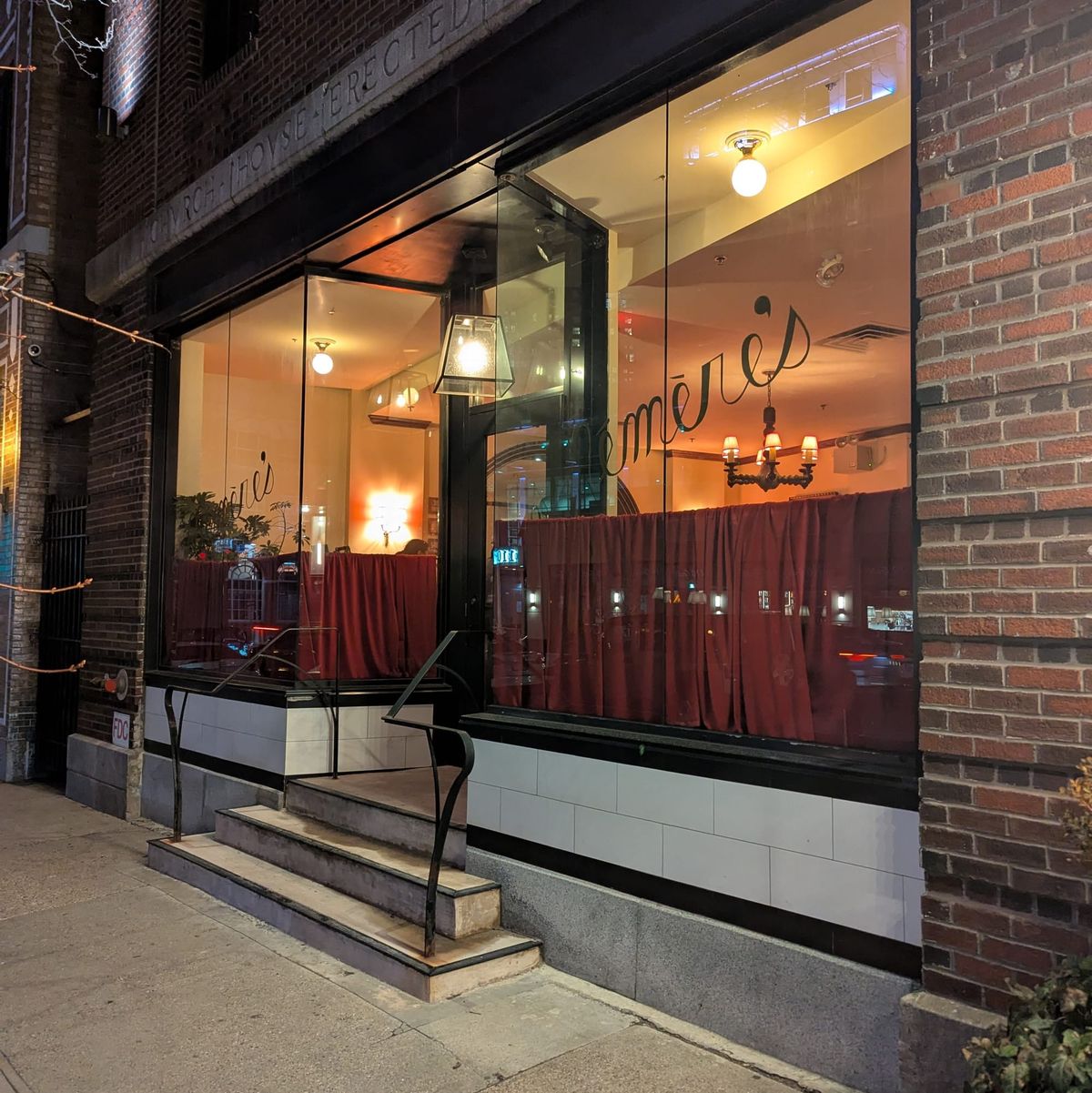
Mémère's is located in the Neptune hotel (formerly the Dean). Both the hotel and restaurant spaces were, for many years, the Sportsman Gentlemen's Club, an extremely misleadingly named establishment in that there were no men of sport or gentlemen located in what was in actuality a brothel.
For several years, the claim was that Rhode Island was the only state beyond Nevada where sex work was legal. This was wrong: Rhode Island had, for many years, simply never passed a law that criminalized soliciting for sex while indoors. This oversight came to general knowledge when it was successfully argued in a criminal case that the defendant had been charged with a crime that did not exist in the state. So, for a very brief time, sex work indoors was not something prosecutors could charge for, essentially decriminalizing it without legislation saying so. Advocates will point out that this ensured a great deal of protection for sex workers, chief among them that assaults could be reported to police without fear that the person who was assaulted would be arrested for prostitution while the john or pimp got away scot-free.
The state swiftly criminalized the whole endeavor following that event.
The only real lasting decorative feature that remains of this somewhat sordid history of the building is the floor in both the Neptune's lobby and Mémère's, which are small octagonal white tiles. Your sister and her husband, the same one texting you about Mémère's hospitality, stayed there when it was the Dean when they flew back from LA to get married. You visited their room a day or two before, your sister and her friends arriving like conquistadors in yours and Ophelia's apartment so that they could make the table flower arrangements. Saga barked and then sat around supervising. You don't remember what you did beyond cutting stems. Ophelia made the centerpieces for each table herself by hand, each a glass cloche that was then divided among the key family members and friends. You and Ophelia kept three, and when you left Ophelia you kept one.
Which is to say, you remember the bridal suite being quite small.
The tiles in Mémère are covered in Persian rugs, red the primary hue, and you and Sir Toby are seated at a table that feels somewhat in-traffic, but lively. Sir Toby has a plan, which is that you will divide the dishes you get between the two of you for maximum coverage. He insists on the foie gras, which you have never had and have read much about the ethics of, but you push all that aside with the thought that you should move as the night takes you. You order beef tartare, foie gras, a salade, canard and bœuf tenderloin (the menu lists everything in French). The tartare comes with a quail's egg cracked on top, the shell along with it for presentation, and Sir Toby decides he'll keep the frail speckled thing as a memento, a request which both mystifies and delights your server. This is Sir Toby's peculiar magic, and why you count yourself lucky to have come into his friendship, that his enthusiasm is endlessly disarming. The word "mercurial" gets thrown around an awful lot these days, but...
You maybe can't see that you find the foie gras to be a lemon worth the squeeze, but Sir Toby declares himself to be a "foie gras freak," so you decide that it's your first time, and defer to his palate. It is eminently rich, you will give it that. The asparagus arrives, which is when you make your intimation to Toby about the case of mistaken identity. You divide the salade between the two of you. Your notes are conspicuously absent any impression of the salad. You are not necessarily surprised. It's salad. An Italian teacher once told you that Italians use salad as a palate cleanser between courses, rather than as an opener, and that makes a lot of sense to you.
One of the dishes has a version of Thomas Keller's potato pave served with it. The first time you heard about potato pave, you had to try it, which is another thing you consider a lemon not quite worth the squeeze, but as long as you're not doing the squeezing, you're perfectly content with them. These are much better seasoned than yours, and cut into rhomboids, the sharp points making the lamination of the potatoes stand out more.
You ordered a non-alcoholic Suze tonic in the rush of making decisions that precedes any meal, and you're finding it a difficult item to use to rehydrate your mouth between bites, given without the alcohol it is purely bitters. So you order an Athletic as well, and your waitstaff offers to clear away the Suze as well. You refuse this, as you have decided that you will wrestle the taste to the ground and acquire it one way or another. The Athletic is brought to you as a can with a Belgian Ale style glass, only in miniature, you cannot imagine it holds more than five ounces full, which is a novelty and makes drinking it feel significantly classier than it generally does.
It may be impossible to ever describe beef as "effervescent" but if so, then Mémère's tenderloin has come as close as the laws governing matter allow. It more or less dissolves on the tongue, something like butter. Certainly, between you and Sir Toby, it is quickly divided and devoured. You can't say you notice the truffle which was shaved at the table, which is maybe your own personal failing for eating too quickly, but you are as you have been made.
Similarly to the beef, the duck melts away from the bone when you begin to cut into the thigh you have been presented with, and you wonder about the sauce, the closest flavor you can place it as a tamarind, but Sir Toby recalls that it's a blueberry gastrique, which would make far more sense. You can't help but be glad you made the decision to order it. Duck is one of those items you delight in, but grow extremely trepidatious about doing at home. Some things are best left to the professionals, and this is professionally-made duck.
Mémère's, according to their website, is "inspired by the spirit of family tables—where food is generous, stories are shared, and everyone is welcomed" and thus has been named the French Canadian word for grandmother. Your father's grandfather was a French Canadian immigrant to Maine. During your childhood, his ceremonial sword given in recognition of his service in the Spanish-American War kicked around your parents' basement, and then your aunt finally gave the photograph portrait of him with the sword across his knees to your father, where it hangs at the bottom of the stairs. The picture was almost certainly taken in black and white and then colorized after the fact, but whoever did so gave him the startling pale blue eyes that characterize yours, your father's, your twin brother's and your sister's eyes.
Your father tells you a story that his grandfather told him. In Cuba one day, Teddy Roosevelt thrusts his pince-nez glasses out at your great-grandfather.
"James!" he says. "Clean these!"
Your great-grandfather dutifully cleans Roosevelt's glasses, hands them back. Roosevelt puts them on and examines the clarity.
"Bully!" he declares.
And then he charges up San Juan Hill.
In reality, some light research suggests that your great-grandfather was a private in the 1st US Volunteer Infantry, who enlisted in May 1898 and was mustered out in November 1898. He would've been nineteen in the war, which lasted from late April until mid-August of 1898. By 1910, he was likely a first lieutenant in the Coastal Artillery branch of the Maine militia. It's unlikely he ever crossed paths with the future President, who led the 1st US Volunteer Cavalry (called "Roosevelt's Rough Riders" although they were originally nicknamed for the first commander as "Wood's Weary Walkers" a more technically accurate moniker in that their horses never came to Cuba with them), though you suppose it's possible he could have fought at San Juan Hill in July of that year.
It's May of 2026 when you're writing this and you think about that: in 1898, the whole country marshalled for a war that lasted five months. You great-grandfather would have been trained for two weeks, if that, likely enough.
Before the meal, you stopped into the bar at the back of the Neptune. Sir Toby has recently stopped drinking, and you have forgotten to bring your copy of The Naked Mind, which is the book that provided the final coffin nail in your drinking days, which you mean to loan him to help him along. Like most self-help books, it's not exactly a professional's idea of an intervention, alternating chapters between anecdote on the author's life (a marketing professional by trade) and then fairly well-researched information about the negative effects of alcohol. Its advice more or less boils down to "when you think you need a drink, consider all the things you know about drinking, either its effect on you or in general," which is a sort of barebones cognitive-behavioral therapy redirection of thoughts.
The bartender must confirm with you both that you meant to order the non-alcoholic mocktails, since people are often enough confused. Sir Toby explains he is embarking on his initial mocktail experience, and you get to talking about attempts to replicate the nature of alcohols, particularly whiskey, since the burn is difficult to replicate. And then you are talking about whiskeys in general, particularly the difference between Scotch and Bourbon.
You have heard it said, you forget where, it's one of those folk wisdoms an acquaintance passes along and then the point is remembered long after the person is forgotten, that the best scotch is far and away better than the best bourbon, but conversely, the worst scotch lags miles behind the worst bourbon, which is still, at least, potable. To demonstrate your point, you draw, for Sir Toby, a spectrum of "Bad" to "Good" and then draw a band stretching from one word to the other which you label "Scotch," and then draw another band that stops well before either endpoint and label that "Bourbon."
When the chocolate cake decorated with raspberries and a raspberry sauce and whipped cream on the side appears after you settle the check (your waitress makes sure to place a few new settings of silverware and inform you that one more treat is coming), you and Sir Toby fall into a discussion of the eternal question of cake vs. pie. You both agree that, on the whole, you prefer pie to cake. But you observe that it is once again a Scotch & Bourbon dichotomy. Pie is always good, but it can never reach the highs that an exceptional cake can. On the other hand, it hardly ever sinks to the laborious chore of eating that some cakes can become. This is one of those cakes that rivals (but perhaps doesn't quite exceed) a great pie. Sir Toby finds himself unable to consume his portion in its entirety, but you find it quite easy.
When you tell the story of the mistaken identity to other people, many of them assert that you are, in your own small way, actually a food critic. You wonder about this. It seems to you that you are not a food critic in the way that Mémère's is not a French or Quebecois restaurant by dint of not being in France or Quebec, and the way your Quebecois forebear was not a Rough Rider by dint of not being in the cavalry (or the Rough Riders weren't riders by dint of having nothing to ride), or the way Rhode Island wasn't a state that had legalized sex work by dint of not having a law that legalized sex work: you are not a food critic in that you are not here to criticize food.
But, then again, all of you are (or were) all those things in the ways that matter to the people that it matters to be those things.
This is Mémère's.