010: Kimi's / Hanju Kitchen (RIP)
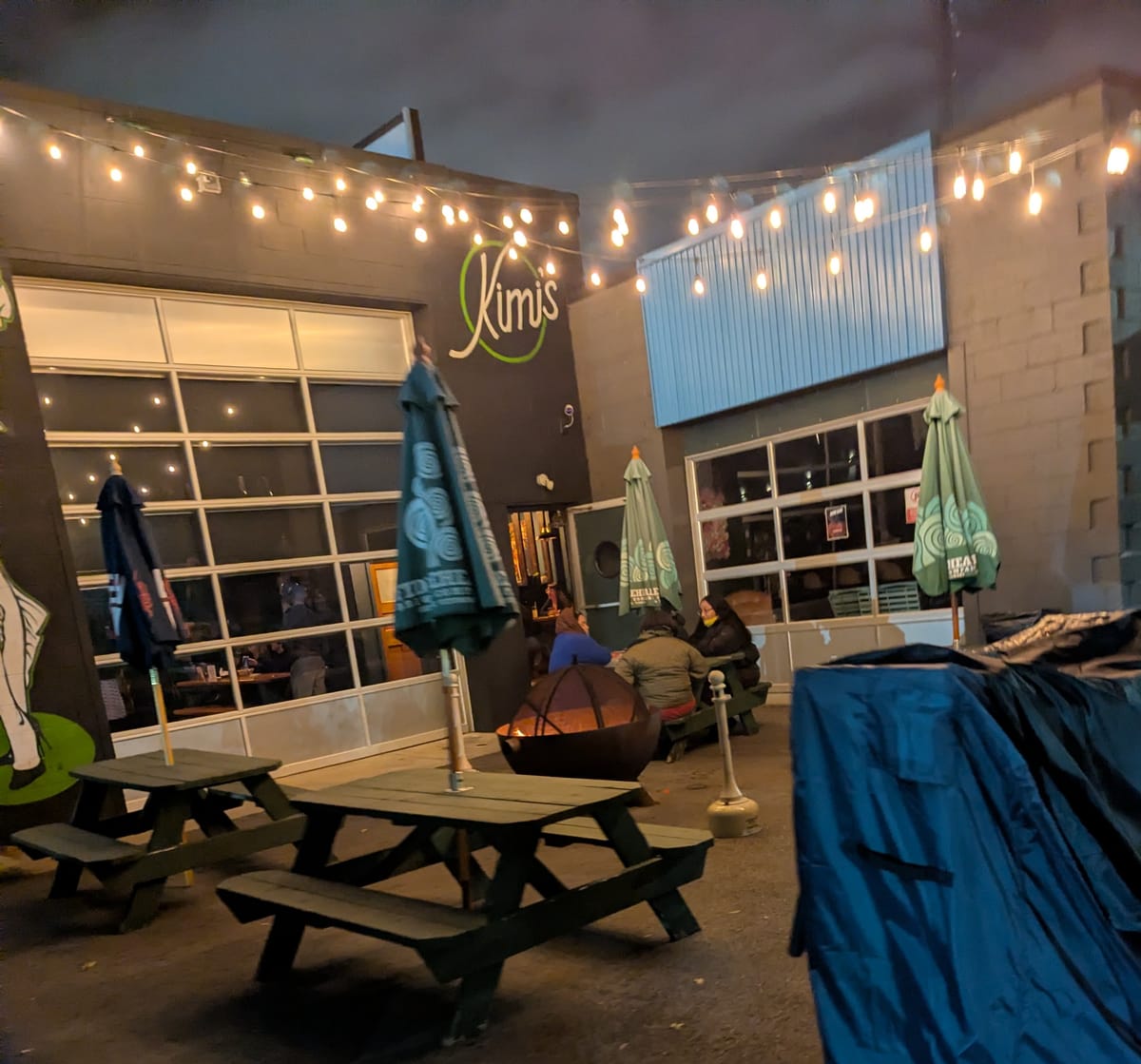
Location: 373 Washington St Street Hours: Monday, Wednesday, Thursday, Sunday: 5pm - 1am; Friday, Saturday: 5pm - 2am Date of Visit: November 7, 2025
This is Kimi's (and the Hanju Kitchen, RIP).
You sometimes think how funny it is that Washington Street is something of a main drag in Downtown Providence, but it starts over in the West End as a rather unassuming T-junction off Knight Street. There's an auto detailing place directly across from where it starts, and you remember that behind it was a doggie daycare that you and your coworker with the unassuming Floridian drawl at your first full-time job out of college would stop at to collect his dog before he'd take you both home to the East Side, since you were neighbors.
I-95 carves a great canyon through the center of Providence, no doubt a plot by the city fathers of the mid-20th century meant to section off the Italians that dominated Federal Hill and the Irish in Smith Hill and Mount Pleasant to their own little enclaves, but now effectively keeps any number of ethnic minorities at arm's length from the center of the city. In fact, it appears to have worked a little too well: with the Providence River in the north, Downcity is effectively an island drained of much in the way of a permanent population, a place no one has ever told you they wanted to live. But, somehow, once you cross over the interstate and into the west side of the city, it still feels like you hit a wall of inactivity. Case in point, Kimi's is in a block, squeezed between the Bom Cafe and Pretty Things Studio, a permanent makeup clinic, all housed in what was clearly, judging from the bare unfinished floor of irregularly stained concrete and the garage door prominently visible next to the actual entrance, another automotive repair shop somewhere in its past, which by your count would have made at least five different auto-repair related businesses in the same four-block area if it had been a contemporary of the four still in existence. Indeed, Kimi's and its neighbors rise out of the landscape of eight different parking lots spread across two blocks, most of which service the Providence Public School Department.
It's what used to be, when you were a kid, an unseasonably warm night for early November, the low 50s, but now feels a bit too cold for comfort. On your way in, they'd already started up the fire on the patio for the handful of people sitting at the green picnic tables and benches. Everyone is wearing winter coats, including you, even though the season will not technically start for another six weeks. All of you are living in anticipation of a coming cold that exists only in your collective memory, knowledge, and intuition. You can't know how right you will be until it finally comes on, two months later.
You're coming here because it is one of the last nights for the Hanju Kitchen at Kimi's, and one of your trivia buddies is friends with the chef. She is leaving the United States. She is returning to South Korea, according to your friend (and now the Providence Eye), because she finds the proposition of remaining an immigrant in the United States increasingly untenable under the current administration.
Less than eleven months earlier, the then-Korean President, Yoon Suk Yeol, attempted to declare martial law, suspend the legislature, and arrest several legislative leaders, including members of his own party. The result led to dramatic scenes: Koreans taking the streets to keep their democracy just as they had in 1987 to win it. Police barring legislators from returning to the National Assembly building, leading to a video of the leader of the opposition Democratic Party Lee Jae Myung, sixty-two at the time, scaling a fence to get in. 190 legislators out of 300, aided by private citizens outside, made it in, where they and their staff used furniture to barricade the doors to the main chamber against the arrival of their own military's special forces, while staff outside sprayed soldiers who attempted to enter with fire extinguishers. Soldiers reported having been deliberately kept in the dark about their mission until they arrived. The Democratic Party's spokeswoman outside, thinking only of the need to stop what was happening, attempted to pull a rifle out of a special forces soldiers' hands, and he leveled the gun at her for a moment, at which point she shouted, "aren't you ashamed?" at him and he walked away. The army's chief of Special Warfare Command later testified that the defense minister and the president personally ordered him to have the legislators dragged out, and strongly implied that prosecutors were attempting to shift blame from Yoon to the defense minister for issuing what was an illegal order. A unanimous vote in the early hours of December 4th to lift martial law by those present rolled back Yoon's extraordinary attempt at a self-coup, even as the President was raging at the army and police to cut down the doors with an axe and shoot legislators if necessary.
The aftermath is somewhat extraordinary from the perspective of an American. Within days, the National Police Agency (NPA) raided the office of the President and several other offices, including defense commands such as the Special Warfare's, the local Seoul Police department, the NPA's own offices, and National Assembly's Security Service. For American context, this would be somewhat like the FBI raiding the West Wing, the Pentagon, the DC Police Department headquarters, the U.S. Capitol Police headquarters and the J. Edgar Hoover Building. Yoon was impeached and removed from office, pending trial while an acting president was appointed (actually two, as the first was also impeached). A month later, after he refused three requests for interviews, a federal court issued an arrest warrant for the President of the Republic of Korea, which was attempted at the president's resident by the NPA twice, the first time resulting in a standoff with the President Security Service, leading to the arrest of its chief on obstruction charges. A human wall of staff turned the NPA away. They returned a few days later, this time climbing fences and cutting through locked doors from all sides, facing another human wall, until Yoon eventually surrendered. A trial took place, and he is currently sentenced with five years in prison for the first of his four trials, and last week received a life sentence for insurrection. The prosecution had requested the death sentence.
Lee Jae Myung won the special election to become President in June 2025.
This sounds a bit chaotic to an outside observer, and it's hard to imagine wanting to leave the United States to return to this, but it's also something of a statement that of the eight people to serve as duly elected Presidents since South Korea regained popular democracy in 1987, fully half of them have been successfully convicted of crimes (and the investigation into a fifth was cut short when he ended his own life), including two whose prosecutions started while they were in office. In a somewhat bitter irony, two convictions were secured by Yoon himself during his time as a public prosecutor. If anyone has answered "Quis custodiet ipsos custodes?" ("Who will watch the watchmen?")[1] it may very well be the people of South Korea.
By February of 2026, however, even a very white boy like you can hardly fault the logic of wanting to leave the country. Your president, who has attempted his own auto-coup five years before Yoon's but who escaped anything remotely resembling punishment or accountability for it, has sicked a literal secret police force on immigrants of all stripes, primarily racial minorities. His federalized goons have shot several people and killed at least two in broad daylight on the street for having the temerity to record their violence. There is no doubt that many more have died in concentration camps constructed around the country, where people snatched off the street, immigrant and citizen alike, are whisked away to within days or sometimes hours of their initial arrest. Virtually none of this is legal, even operating within the the Supreme Court's well-established jurisprudence of dispensing with the Bill of Rights if ICE or CBP has even a slight suspicion undocumented immigrants are in the area.
You have been attending marches, to the point where you're wondering about buying a flag and teaching yourself embroidery off YouTube videos in order to stitch a motto into it and therefore reduce the need to make signs; the idea of what the current administration is doing feels to you like a strike at the very core of what it means to be an American. You internalized "a nation of immigrants" very early on in your life, although you cannot point to the exact moment when. Perhaps the immigration unit in fifth grade when you got to go to Ellis Island. There is an old wives' tale that much of the Anglicization of immigrant names, the peculiar half- and misspellings that characterize many of the American branches of families, were awarded to them by immigration agents at Ellis Island unwilling to both learning the specific complications of Polish or Italian or German. The reality is that many of the immigrants who passed through Ellis Island believed strongly in assimilation, and that often included one's own name. The thing about wanting to come to America that people often forget is that it is almost always hand-in-hand with wanting to become American.
To your mind, there are few other places where this "melting pot" or "tossed salad" or whatever other food-based immigrant compound metaphor you prefer that characterizes the United States expresses itself as clearly as cuisine. Case in point, the Hanju Kitchen that operated out of Kimi's fused Korean food with Cajun food to form "KoCajun"—in essence, a synthesis of a synthesis, given Cajun's combination of French and American cuisine. You order a "Bul Dog," the combination of a hotdog with Korean bulgogi. The menu also contains a gumbo and a kimchi mac and cheese (with optional bulgogi—three dishes on the menu allow for the addition of bulgogi). And then, of course, there is dessert which is American as apple pie[2] since it is apple pie bread pudding. It comes out piping hot with ice cream melting on it, the contrast pleasant enough, especially as by this point Kimi's has opened the garage door, letting the November evening air in.
A cursory glance at American history reveals a country in constant tension with its own origins, with one hand welcoming newcomers to its shores and telling itself the story of a dream fulfilled when someone comes here with nothing and turns themselves into a business leader or celebrity or politician or some combination thereof: Andrew Carnegie, Billy Wilder, Arnold Schwarzenegger, etc. etc. people who become inextricable parts of our country's history and culture. But with the other hand, shunting them aside, pushing them into the margins, and going through recurring waves of blinkered nativist thinking that pretends like everyone who got here a few centuries earlier moved in when Pangea broke up and all the country has been built by an exclusive cabal of white men since time immemorial. There is a irony, to you, that much of this nativism focuses on the idea of "losing your country" to immigrants, since to lose immigrants would be to lose America itself.
And so it is that Hanju Kitchen is lost, the deliberate blended family of Korean and Cajun hosted in a place so American there is an animal skull over the bar. With the garage door open the people who smoke go out to smoke, where the tables have filled in around the wood fire going in a large brazier, and you go with them to share a joint. You amuse your friends when you do, because for whatever reason you never seem to experience getting high when you use cannabis. You can remember the first time in college that you may have when you got a brief moment of swelling euphoria, wasted during a trip to the urinal. But since then, nothing. You can only live vicariously in your friends' somewhat glazed over-focusing as they slowly fall under the influence. A not small percentage of you are about to hit a rough patch in your lives, maybe spurred by the cold and dark of the impending winter. You'll have nothing but your own wits to confront yours with. And, of course, it is not like you can console yourself in alcohol in the meanwhile, since you no longer drink (wonderfully, they do sell Athletic N/A beer at the bar in Kimi's).
Some days it feels like even your vices have abandoned you.
Or maybe they also had the good sense to go away before things got worse.
This is Kimi's (and the former late Hanju Kitchen).
Some readers—perhaps even just one—may find it patronizing to have this translated for them, so to avoid that feeling, consider instead focusing on whether or not the correct translation should have been, "Who guards the guards themselves?" ↩︎
Apple pie is not anywhere close to American in origin, having been independently invented by the English, Dutch, French, and Swedes before Europeans began colonizing the Western Hemisphere in earnest ↩︎