009: CRU PVD
You shouldn't begin by waxing rhapsodical about Bayberry Beer Hall, the previous tenant of this space, anchoring a corner of West Fountain, a stone's throw from the Public Safety Complex and its attendant garage. CRU, for example, does not serve the chicken and waffles with spicy honey
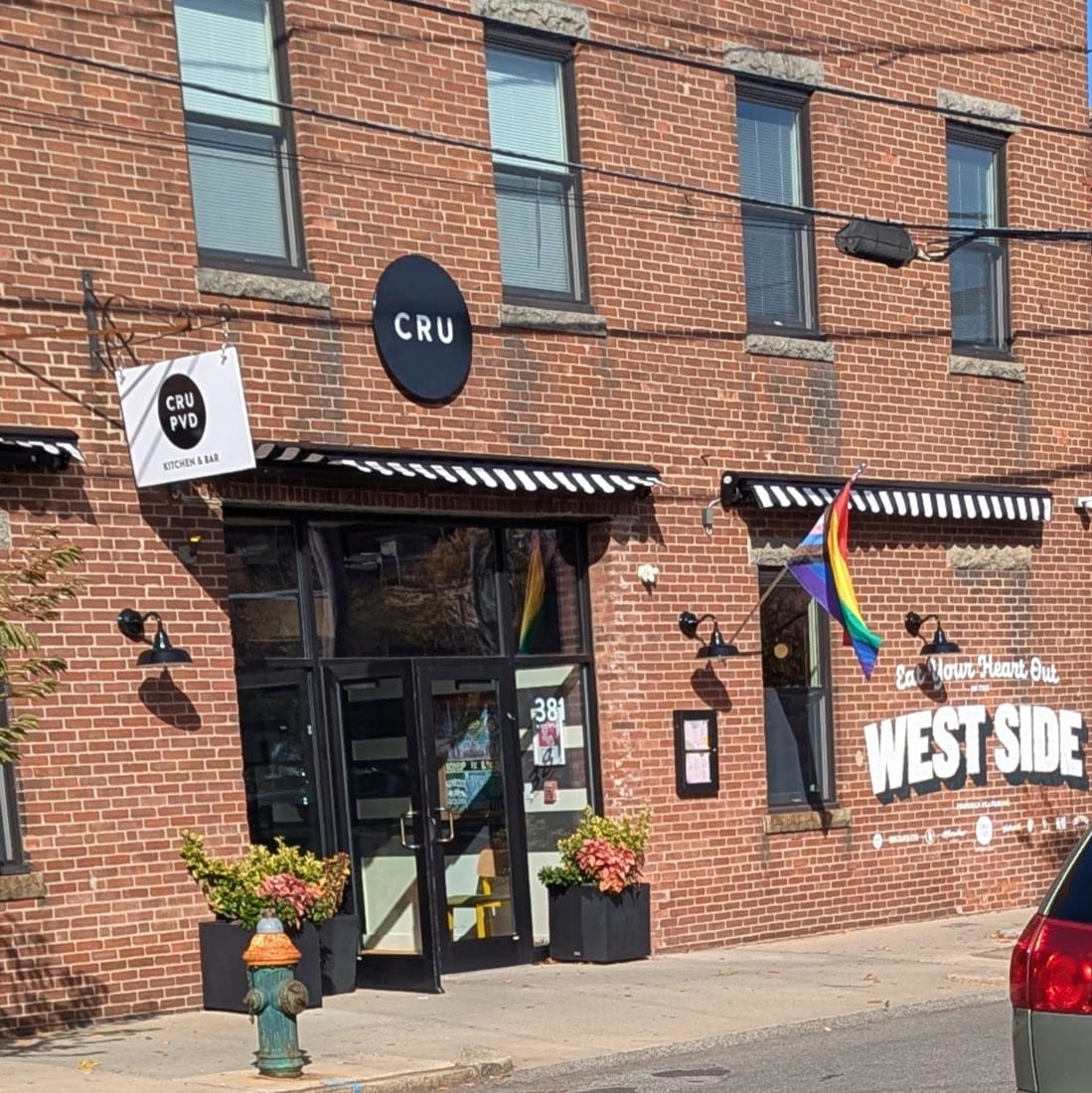
Location: 381 West Fountain Street Hours: Paused Indefinitely as of 2/2/26 Date of Visit: January 31, 2025
This is CRU PVD.
You shouldn't begin by waxing rhapsodical about Bayberry Beer Hall, the previous tenant of this space, anchoring a corner of West Fountain, a stone's throw from the Public Safety Complex and its attendant garage. CRU, for example, does not serve the chicken and waffles with spicy honey that you ate there when your twin brother and his now wife had their celebratory engagement brunch. You have a special fondness for chicken and waffles from the scant two years you lived in Asheville, North Carolina. About a month after Phebe, the woman you loved between Ophelia and Viola, had told you she didn't think she could love you ever again, you ordered chicken and waffles while on a date with a sewing machine sales woman that certainly wasn't the start of a single thing. You got pretty badly sunburned, went home, attended your parents' 35th wedding anniversary, and then immediately developed COVID the very next day. You can't blame it on the waffles, although in retrospect it was too much of a meal for a first date. And Bayberry isn't dead, a eulogy would be premature, this was just a limb that was amputated in favor of Bayberry Garden on Dyer.
CRU is a Russell Morin's Restaurant Group production, a subsidiary of the same company that now runs half the Providence Public Library as a private event space. The CRU Cafe lives in Newport, and while you've never been to the Cafe to compare, this appears to be a proper restaurant version, with a hostess, seated dining, a dinner menu, etc. etc. You've been called out tonight because Quince and his wife, Quickly, have invited you to fifth wheel it with their gregarious friends, Ulysses and Ursula. You enjoy them and you're trying to be more social.
You and Quince arrive first, the others trickle in shortly after. You secure a circular table that is tucked away by the front, with curved bench seating that you slide into so as to solve the dilemma of who will be the person who must ask someone else to stand up in order to use the bathroom. It will be you. It places you in the extreme corner of the restaurant, hemmed in by Quickly and Ursula, while Quince and Ulysses take the chairs next to their spouses. It's the first time for all of you, and you take in the renovated space with a critical eye. It strikes you as unfailingly familiar, of retaining hints and pieces of Bayberry, but very different, its own entity. It's not a fair comparison, but all the same the image flashes of Anthony Hopkins in Silence of the Lambs wearing someone else's ill-fitting face over his own. This is uncharitable, and it feels more so when the waiter welcomes you all as neighbors when he finds out you're all live within a five minute walk of the restaurant. You, in fact, come past here nearly every Saturday and Sunday on Saga's second walk of the day.
You order a shrub, a drink made from from a flavored sweet vinegar syrup and which arrives pink and fizzy in a highball glass with a paper straw. You have a book of non-alcoholic cocktails to make, to get some utility out of your bar set from your drinking days, but you have made precisely none of them because so many rely on shrubs or syrups which must be made rather than sourced, using the recipes transcribed for your convenience on the pages after the pages with the recipe for the drink you wanted to make. With liquor, most of the ingredients will last up to months, if not years. But with mocktails, these things last for a couple of weeks at the outset. If you make the Sunomono, which appears to be a very refreshing cucumber drink, you must first make the Sesame and Salted Vinegar shrub, which produces 12 ounces of the stuff, when the recipe only calls for one ounce per drink. Will you like the drink enough to make it a dozen times?
There's simply no way to know.
So when you see a shrub on the menu, you take the chance to have it made for you, rather than by you. You could drink the one at CRU several times over, if it weren't for the price, which is competitive with actual cocktails.
Quince and Ulysses order off the menu proper, which your brain, ever a rules-follower, finds vaguely gauche. Your eye is drawn, on the Restaurant Week menu, to the duck confit raviolo. Duck and pasta, you have a fondness for both. You took, from middle school into college, eight years of basic Italian, and while you never really mastered anything beyond counting random produce, you know enough that you should've have clocked that "raviolo"—by dint of not ending in an "-i"—is the singular version of "ravioli." You attempt to hide your disappointment when one giant piece of pasta, the lump in the center about the size of your palm and maybe three-quarters of an inch tall, sitting in a shallow bowl of broth.
It occurs to you, looking at Quince's much heartier plate, that Restaurant Week menus are often a gimmick where the establishment offers a deal, but it's generally on a far more economical dish than their normal fare. You suspect the flowers floating in your broth are edible, but you've never heard someone say, "gosh, I'm full—I think I ate too many flowers."
A woman and her date enter CRU and sit directly at the bar in the spot where, due to where you're sitting, you look at most often. You think perhaps it is not Viola. That your mind is playing tricks on you. Her hair was darker, surely, when you knew her. With only whisps of grey and white around the temples you found enchanting.
She looks back and sees you, and you lock eyes. It is almost certainly Viola. Your chest hurts, your breath shortens, and you know it is your cartilage inflaming from stress. She turns and says something to her date, and he reaches over and rubs her back. You used to do the same, when the two of you brushed your teeth together at night and you caught her eyes in the mirror. An ungenerous part of you wonders if he does the same thing you used to do, if he reaches around her waist, and squeezes her tight to his side, if she stole that little gesture of yours for him to use.
It's those little, tiny pieces of a person that win a heart. That smile, the gleam of her eyes, the way your hand found her hip, the warmth of her pressing into you, is something you used to sometimes think you'd give ten years off the end of your life just to experience that again for ten seconds.
People have battered you with tautologies and cliches: it didn't work out, therefore it wouldn't have worked out. She didn't tell you she was unhappy, therefore she couldn't tell you she was unhappy. That it was her problem, there was nothing you can do. That a lifelong partnership is built on navigating the lows as well as the highs, not running from them. They always mean it to comfort, and you always fought it, defending her for hurting you. Whatever memory of co-dependent prior relationships you triggered at the height of your depression, she knew you for only four months. You begged to be given the opportunity to fail her the way other men had failed her because you knew you wouldn't. You can see the hollowness of that promise, how many times she must have heard it before. You can see the bravery in recognizing a pattern early, in breaking the chain, no matter how much pain it might cause.
The last time you spoke with her, a frantic, desperate phone call, she told you she didn't want to hurt you, and you told her she couldn't, that it was all part of the same hurt she'd already inflicted. And then she demanded to know if you thought she hadn't done everything she could to save the relationship, the anger thick in her voice. It struck you as a complete non sequitur, but you told her you did believe it, that you had shut her out, just as she accused you of doing. You told her you loved her and she said nothing in return. Afterwards, to spare yourself further embarrassing yourself, you purged your life of nearly all of her, deleting all your photos of her, all your contacts for her. Early on you used to make a point of drilling to remember her cellphone off the top of your head, to be able to call her if you lost your phone, but luckily for you it's a memory that has been long since lost.
In the aftermath, you think of the things that undermine your affection. That she lied to you about being okay with roasting as a form of flattery, until one day she told you to not make fun of her in a very small voice, then burst into tears when you asked her if she was kidding or not. Someone else had made the jokes and meant them. That after the fight that apparently led to the end of your relationship, she pretended like nothing was wrong for two weeks while she steeled herself for the breakup, rather than coming to you in a quieter moment and talking about what troubled her, like you'd told her she should always do, while in the same breath accusing you of keeping yourself closed off from her. That she never let you pay for anything until suddenly she was sharply talking about splitting food costs like you hadn't been suggesting that from the start. That she didn't say anything when you told her that you were deleting your dating apps shortly after you'd exchanged "I love you." You understand now that she fled from the necessary friction that negotiates the love between two people. These things remind you that love can be counterfeited, even if the counterfeiter isn't intentionally perpetrating their fraud. They can love you, but then neglect the trust and honesty that give love its true currency, creating in its place a hollow, brittle thing, that presents itself as unbreakable but shatters the first time you place real strain upon it.
Reflecting on it, you know she didn't do everything she could do. Maybe she did everything that would've worked, you can accept that. And you know you didn't do everything you could either. But you knew how to do it; when Ophelia and you first moved in together and had friction, you made a point to dedicate a weekly hour to discussing the relationship itself. And you kept that hour through thick and thin, and it became easier and easier to discuss the relationship as time went on, even spontaneously when not in the hour. Enough that, six years later on a random Thursday evening in early December, you were able to tell her you didn't want to marry her anymore.
You wonder sometimes if it wasn't like your Italian—if you'd stayed vigilant and alert and observant, you might have noticed the -o in place of the -i, and seen something was wrong. If you'd applied the knowledge you'd developed over years with Ophelia, you might have averted disaster with Viola.
But you are also not confident she knew how to do what else she could've done.
Here you are in CRU, a year later, and nothing she feared has come to pass. It took work, you know. But you are who you knew yourself to be, insecurities not withstanding. In a couple of weeks you'll complete your first sober year. In a couple of months, you'll launch your newsletter. No one will ever push you as hard as you push yourself. You've dated two women in a row with training in psychology and Prospero tells you that you're falling for women who would stick you in a box, categorize you in amongst others, rather than let you carve out your own niche. "Stop dating people who want to tell you who you are," he says. "Date people who want to let you be who you are."
She never knew you, and you never knew her. You understand now that knowing a person doesn't involve just mapping out their terrain as it is. To truly know someone, you must know the space between who you want them to be, and who they want to be. There's an irony in that you think you know her much better now, with however many miles between you, looking back, then when you wrapped her in your arms and spoke to her staring her in the face, looking forward. But it's a bit of knowledge that, more likely than not, will never actually be tested, a hypothesis waiting patiently for you to fail to disprove it.
A few weeks after Viola left you, an older friend told you about how she'd once gone through a breakup and spent the next four years heartbroken over it, nearly four times as long as the relationship itself, that it had taken that long to move on. And then, one day, she'd woken up and was finished with it. A slow, gradual, recession of her love until at some point all she could recognize was the complete absence.
You spent several months reading accounts of people who'd broken up, or gotten divorced, and then gotten back together. A man who divorced his husband for drinking and depression, only to reach out three years later of no contact, to find that the ex had achieved sobriety—he'd had one more rung down the ladder to fall before reaching rock bottom, crashing a car and losing a license, but he'd done it, and spent the three years rebuilding his life—and finding their love still very much alive. A woman who'd been in a long-distance relationship that had fallen apart, only to walk into the same bar in Italy she'd first met him in ten years earlier, and finding him there. The comedian John Bishop, making a joke at his ex-wife's expense on stage without knowing she was in the audience, and making her laugh for the first time in years.
There is a paradox that emerges from these stories. For the relationships to reform, the participants went on with life believing that it would never happen, that they'd loved and lost and that was all there was to it. Serendipity—fate, if you prefer—placed them in the way of each other. If something were to happen in the future, it will require that you live with and operate from the knowledge that such a future will never come to pass. And so there is really no choice. You have to go on living. You will build the rest of your life for yourself, confident in the knowledge that whatever role Viola was meant to play in it is complete, done and dusted, gone forever. And either time will prove you wrong or you will no longer care that you're right. Once upon a time, you loved Phebe and had your heart broken and it took meeting Viola to put the last nail in the coffin for that love. And so you can believe that the next person, if such a person exists, will in turn allow you to seal up Viola's coffin.
You cannot believe in ghosts and it is the ghost, not the person herself, you are heartsick over. Prospero points out to you that treating these sightings as hauntings holds her in that paranormal state. And he tells you that people who don't believe in ghosts may still be haunted by them, but they needn't stay haunted when those ghosts are gone.
There in CRU, among your friends, your attention turns away from the ghost and back to your table, and the topic is childhood toys, and with some relish, you launch into a description of the slammer you had for your Pogs, which was a heavy brass thing cut in the shape of a sawblade, with actual, blunted, teeth that if you threw it wrong would punch big dents in the Pogs. There is a brief tension as Quince asserts, having known you from when you were six, that had you possessed such an item, you would have eventually thrown it at your twin brother. You insist there were limits.
From time to time, you glance out of the corner of your eye, and you think you catch Viola looking, the more animated and cheerful you get. The pain doesn't go away as easily as you shift your attention, and even now, writing, you can feel its echo pulling at the walls of your chest, but it lessens. When the night finishes, you tell Quince and Quickly that Viola appeared in the middle of it and sent you spiraling.
"You hid it well," Quince observes.
A few days before you come up on a full year between the visit and finally finishing this essay, CRU PVD posts to Instagram an announcement that it is "taking a step back to reassess how this location can better reflect what the people of Providence want and value." They assure that the pause "isn't about walking away" but nonetheless, you have been through this enough times to believe that you need to get this essay out now. You've made a commitment not to write about places that are completely closed, and it forces you now to power through your inherent discomfort with everything involving Viola. It feels like life has stolen a march on you when you weren't looking and you are scrambling to keep up.
You know that there is a point at which revision is simply procrastination, and maybe this essay reached that point four drafts ago, and that forcing your hand now is perhaps the only way it will ever be published. But still you feel like it is out of order, like it is not coming the way you had planned, the way you had intended.
But, of course, you do not get to live life the way you intend, you get to live it the way it comes. And you have to live on knowing that the future you envisioned in the past will never come to be. And that it is possible it was never going to come to be even if you'd done things exactly as you planned.
This is CRU.
P.S. This post is being published on February 6, 2026, the last day of the second full year of my sobriety.