008: West Side Diner
And service at the West Side Diner is fast enough that you're handed a cup of coffee practically as you sit down. To call the meal "simple" is to do it a disservice
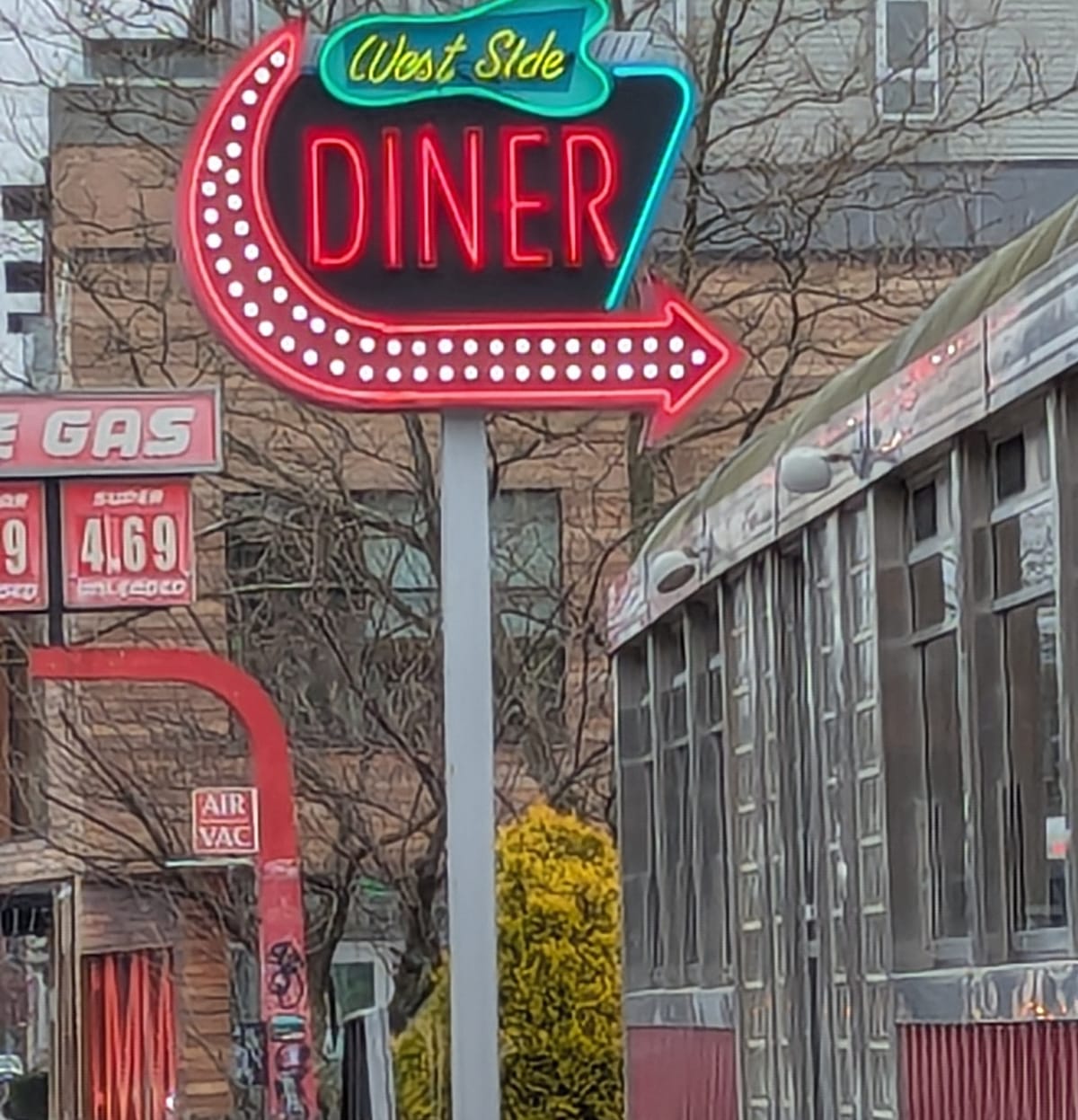
Location: 1380 Westminster Street Hours: Monday to Saturday: 6am to 2pm, Sunday: 7am to 2pm Date of Visit: June 12, 2024
This is the West Side Diner.
You live less than 500 feet from it, according to Google Maps. And, yet, you hardly ever go here. You walk by every weekend with your dog, and you've been glad your sunglasses are mirrored, because it lets you peep at every person peeping through the windows at Saga. One afternoon you came by just after they'd closed, and two of the waitress standing outside asked if they could pet her. You've never seen them again, and sometimes you wonder how it was you timed it just right that day that they should be there. Seven years ago, right when you moved here, right when you got her, Saga used to drag you down Westminster, refusing to stop for anything or anyone, nervous from every bus and truck that came rumbling up or down the street. Today, she mostly plods along beside or behind you, and pulls only to meet the people she sees, ignoring the traffic almost entirely.
You remember the first time you came here, during a lunch break from your first full-time salaried position after college. An Azorean Portuguese coworker who'd been born in Fox Point took you. Your grandmother, who has lived to be 100 the year you publish this, is also Azorean Portuguese, only from Connecticut's Portuguese community, not Rhode Island's. Fox Point was once a poorer Portuguese neighborhood, more or less. Now, much like the West End, it is on the edge of "affordable enough," for couples in their 30s and 40s to buy condos and for white collar workers and Brown University students to afford rent, if just barely. There's still a Portuguese footprint there. There is a liquor store named Madeira. There's a butcher, with the very nondescript name of "Central Meat Market" where they speak English at the counter and Portuguese among themselves, and for $80 you would buy bundles of meat that would last you two or three months, which you used to buy when you lived with Ophelia. Once, Ophelia bought a haunch of lamb from them, and you braised it in Rainwater Madeira for hours.
The Azores (Açores, in Portuguese) is an archipelago that sits in the Atlantic, almost a quarter of the way between the Iberian peninsula and North America. Madeira is another archipelago to the southeast. Both are Portuguese possessions. Rainwater Madeira is a bit like port wine (port is named for "Porto," a city in the Iberian part of Portugal and used to be quite popular in the United States, although its favor has fallen off. There are two theories for the name "Rainwater" Madeira: the first is that, due to Madeira's mountainous terrain, the vineyards on the islands are very steep, and thus can only be watered by the rain. The second is that an American merchant left a barrel of Madeira wine out in a rainstorm. The barrel absorbed the water and diluted the wine to an apparently irresistible taste. The merchant's name is given as William Neyle Habersham, of Savannah, Georgia. Such a man did exist, the scion of a merchant family of Habershams, and William did indeed specialize in Madeira wines in particular. It's certainly a lovely story to think about, although a cynical part of you suspects that it is closer to marketing copy than the literal truth.
The lamb you braised was served to a group of Ophelia's friends and one of them refused to eat it, declining your suggestion he try just a piece. He was apparently a picky eater and you think maybe he'd never had lamb before or had and had found it too gamey. Not that yours was; it had been braised in wine for several hours, after all. You were once a picky eater yourself, but it quickly gave way when you started cooking for yourself and no longer had to eat things as they were prepared, but rather prepared to your liking. Even still, you find it somewhat disconcerting to find an adult who has such a restricted palate that they won't try a new dish, or won't even deign to try something new out of sheer social pressure or politeness. A steadfast culinary hermit.
After that first lunch at the West Side Diner, you and your Azorian coworker struck up an office friendship. The day after the Met Gala, she stood over your shoulder as the two of you went through slideshows and photo reels on fashion sites like E! and Tom & Lorenzo, each of you commenting whether the wearer had managed to pull it off, and if it was even on theme (a sad truth of the Met Gala is that many people select looks that look good on them, and then fail to embrace the theme). You were supposed to be working. When you and Ophelia bought a house in Riverside, East Providence, you recalled she and her husband had lived there when you knew her. You thought you might bump in them while walking the dog, which would be very Rhode Island, but it never happened. You think perhaps they didn't live there anymore. You hadn't heard from her since she was hired elsewhere. Another former coworker from the same job moved in next door to you, though, which was very Rhode Island.
You're sitting at the West Side Diner today with another friend, Escalus, one from your childhood, who you went to middle and high school with, but who now lives in Smithfield with his wife and children. Today you're in the actual dining car part of the diner. Diners have a distinct aesthetic. You don't know if you've ever been in one that felt precisely the same as another, but they generally all have a main part that is one straight row: a bar and booths and big windows. often there are chrome fixtures. The West Side Diner does a brisk amount of lunch business, and on the weekends it is packed to the gills with customers. Many such diners thus have dining rooms in the back or off to the side, where the value of aesthetics is sacrificed on the altar of capacity. To you this is a fundamental rejection of the joys of a diner. The food, in and of itself, is not generally remarkable. If it were high dining, it wouldn't be a diner. No, diner food is remarkable for another reason: it has a distinct unremarkable quality to it. A diner is for reliability, vittles served for the working day, where you'd get something you like, but nothing something you'll fall in love with. Served in the atmosphere of a greasy spoon that could, were it attached to rails, serve it to you just as reliably at 85 miles an hour as it does cemented to the ground.
Your best friend from college, Prospero, once drove to stay with you for a few days, and you went to breakfast at the West Side Diner one morning. It was a weekday, just like it is today with Escalus, and there weren't many people about, so you were able to take seats in a booth, having your coffee endlessly refilled (the mark of an excellent diner is that coffee flows like water, even if it is not the coffee you'd get at a cafe or even at your own home). But, just as you did with your co-worker, you got a meal with chouriço included. The waitress took down your order and departed. But at the edge of your hearing, she went up to an older waitress (and they are all—mysteriously enough—waitresses at the West Side Diner) and said, "do we have this—sure-reese?" Her apparent mentor explained that it was the 'chorizo,' putting a chop into the CH and a buzz into the Z. It confused her when she started as well, she confided. "But that's how they say it here."
It's hard to say there's a difference, because, depending on how it is made, the Portuguese chouriço and the Spanish chorizo are very close to being identical, both a cured smoke sausage, heavily flavored with paprika and usually hot peppers, making it distinctively red inside and our. You doubt you or many other Americans would be able to identify one from the other. But in the United States, you take "chorizo" to imply the spicy, crumbly, fatty ground pork.
You have been struggling to sleep. Today you woke up at five in the morning, three hours after you went to bed, then waited around in your bed for another two and a half hours for your alarm to catch up with you, before throwing on some clothes and taking the dog on a walk. You were out with Saga when Escalus texted, while you were literally around the corner, offering to buy you breakfast. He'll only be there for the next thirty minutes, and you know that the minute she suspects you're turning towards home, Saga will dawdle and stretch a five minute walk into fifteen. But you have so often bailed on him, and he's made the effort to be here, and you should meet him.
And service at the West Side Diner is fast enough that you're handed a cup of coffee practically as you sit down. To call the meal "simple" is to do it a disservice, because if you order something like a breakfast sandwich, as you do sitting across from Escalus, an array of choices to be made will be laid out before you. Bread, English muffin or bagel? Sausage, bacon, or ham? When you choose the bagel, you're asked if you want it toasted or grilled. This is abundance.
Diners are claimed to have their origin in a horse-drawn "lunch wagon" started by a man named Walter Scott, whose primary customers were the staff at the Providence Journal in the 1870s. It might be more accurate to say Providence claims the diner, despite the lunch wagon not having seating. The idea was seized upon and wagon manufacturers begin developing wagons purpose built. At some point, someone had the bright idea to take a passenger train's decommissioned dining car and place it on a foundation, and the primary layout and design of most diners was born, preserved even as they became pre-fabricated buildings. Today, many of them retain that art deco style, the sort of yearning you can see in the 1920s for a new future that made use of curves, geometric shapes, chrome, and neon in abundance, now locked out of time, a century later, the past yearning for a future that never quite came to be. The West Side Diner is on the National Register of Historic Places, and was built by the Kullman Dining Car Company, who were so passionate about the idea of modular construction they build the first prefabricated embassy for the United States' mission to Guinea-Bissau. Once upon a time, the West Side Diner sat on Atwells under the name Poirer's, until it was hauled to Westminster in 2002.
It's a bit ironic, given the modern nation's reluctance to embrace passenger rail, that the diner is one of America's most ubiquitous dining establishments. But Americans' love affair with cars and planes notwithstanding, diners present an aura of being safely American. You can walk into any diner in the country, and there will almost certainly be a hamburger on the menu. They will have fries. The coffee will be bad to middling, but it will be hot and endless or at least cheap. To that point, the West Side Diner calls itself "traditional." And yet, after that, all diners are blank canvasses for whatever person owns them. Across the Northeast you'll find diners serving Greek gyros and souvlaki. The West Side Diner serves Portuguese food. Maybe that's the actual tradition? Maybe it's just local demand? Both together? Who can really say?
All you know is that the staff don't know always know how to pronounce chouriço.
You mention none of this to Escalus, despite the age you've known each other. Smithfield seems an eternity away, even though it is maybe all of 20 minutes away by car (and nearly impossible to reach by any other mode of transportation). He has a beautiful house, on the beautiful plot of land, and a wife and two sons. You wouldn't want to live in Smithfield, you think. And you could go either way on having children, especially sons. You don't envy him, although you'd agree he has nothing to envy about you, either. When your nephew is born to your twin brother and sister-in-law you get a closer glimpse and the whole premise seems even more socially isolating. You've had enough of that for your life.
You didn't always feel this way. When you were dissolving your relationship with Ophelia, the idea that you wanted kids was the only thing that seemed to convince your brother that your differences were irreconcilable, because "bitterly lonely in a committed relationship" didn't seem to suffice. When you started dating Viola, she almost scuttered the first date because your profile said you wanted kids. You told her you weren't going to try and change her mind about it, but you didn't know what this relationship was going to be, so you'd like to cross that bridge when you came to it. Months later, the two of you went to dinner with her friends, and they told a story about a woman they knew who was a lifelong no-kids person, but watching her partner interact with children had caused her to waver. On the walk home, Viola told you she could relate. The only other conversation the two of you had had about it was her observing that if you thought the dog waking you up in the morning for a walk was an annoyance, it would be nothing compared to children.
As the world has grown more wild and vicious, you've untied yourself from the idea. You started telling people you would be happy for kids with the right person or no kids with the right person, it depended on them. What mattered more was that you were happy with yourself.
There is a part of you that wonders if the world hasn't grown so dark and filled with horrors you never even considered that you might not be able to keep a child from the monsters that exist, or keep the world from twisting a child into a monster themselves. There are times when you have traced the trail of your life and seen the places where you might have turned a different way, where you could have retreated into yourself and emerged cruel. That you didn't startles you in the way that watching the bus that nearly missed running you over whizzing past your face does. You know as well, from you and your own parents, that you can't force a child into making every decision as you would make them and at some point you have to get over the fact they have autonomy or risk alienating people you love. You ask yourself what you would do if a child you raised turned that other way you missed going down, and you don't know. Escalus, your brother, you wonder if they've had these thoughts, puzzled out these questions, or maybe the secret to having children is to see the question lurking but not go tilting at windmills until such time as they really becomes dragons. You could ask Escalus this, right now, in this moment, but you let the moment go past.
He has to go, he has to work, and for this minute, you are unemployed and will remain that way for several more months. He grabs the bill.
As you're writing this, it strikes you haven't had chouriço in a while. Prospero could come visiting again soon, and that might be a good enough excuse to sit in a booth in a diner one morning. You know the place, convenient to where you live. You might have to say it "chorizo" instead, but that won't change a thing about it.
This is the West Side Diner.